

Nursery Wall Decor Ideas That Are Cute, Easy, and Rent-Friendly
Decorating the walls of our nursery has been one of the most fun interior design projects I’ve taken on to date. But it can also feel a little overwhelming!
You’re trying to balance aesthetics with functionality, juggling baby monitors and special nightlights, and figuring out all the items that are supposedly essential even though you’ve never even heard of them. And hanging things can be quite stressful.
Plus, everything needs to be absolutely perfect or else the baby will be miserable, right? (Spoiler: the baby does not care.)
Even if the baby may not appreciate all of your efforts, you’re going to be spending a lot of time in the nursery, and creating a beautiful space is more than worth it. And the best part is that it’s totally achievable, even if you’re new to interior design or limited in the changes you can make.
Here are my favorite nursery wall decor ideas that are adorable, easy to bring to life, and rent-friendly.
This post contains affiliate links that earn me a commission. For more information, read my disclaimer.
1. Peel-and-Stick Wallpaper
If your home is like most, you likely have neutral-colored walls. And in many cases, that’s ideal, since your walls need to mesh with your furniture and decor, and constant repainting isn’t always practical.
However, nursery walls often call for a little more life and color (not to mention baby animals).
If you want to dress up your walls without getting out the paint, wallpaper is a brilliant solution. That said, you may not want to commit to traditional paste wallpaper, or you may not be able to install it due to rental restrictions.
Enter: peel-and-stick wallpaper, one of the greatest inventions of the 21st century.
Honestly, I feel like peel-and-stick wallpaper was made for nurseries. There are so many cute prints available, and it’s easy to match your nursery theme. Plus, it’s easily removable if you want to change up your design for future children.
You don’t have to wallpaper the whole room (although you certainly can). But even a simple accent wall can make a big statement and bring personality to your nursery.
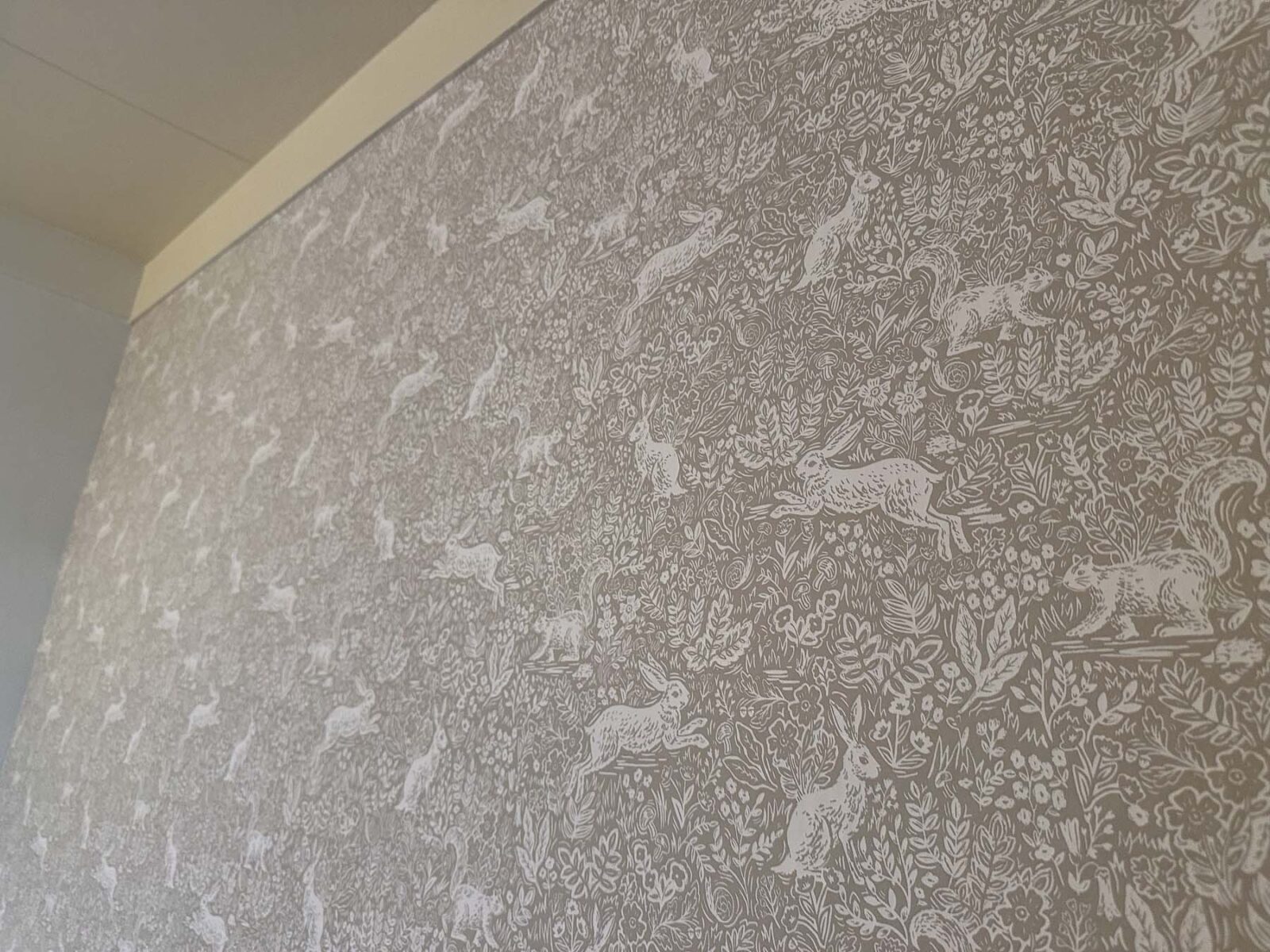
Note: Peel-and-stick wallpaper is very possible to DIY, but it does come with some challenges. Check out my post on common mistakes so you can be spared some of our frustration.
My biggest recommendation: if you’re new to installing wallpaper, don’t skimp on quality — it really matters!
2. Accent Mirror
It’s no secret that I love a good mirror (our house is full of them). And the wall of a nursery is a great place for an accent mirror.
An accent mirror makes a design statement, reflects light, and helps make the space feel larger (and let’s be real, nurseries are often quite small — ours is tiny).
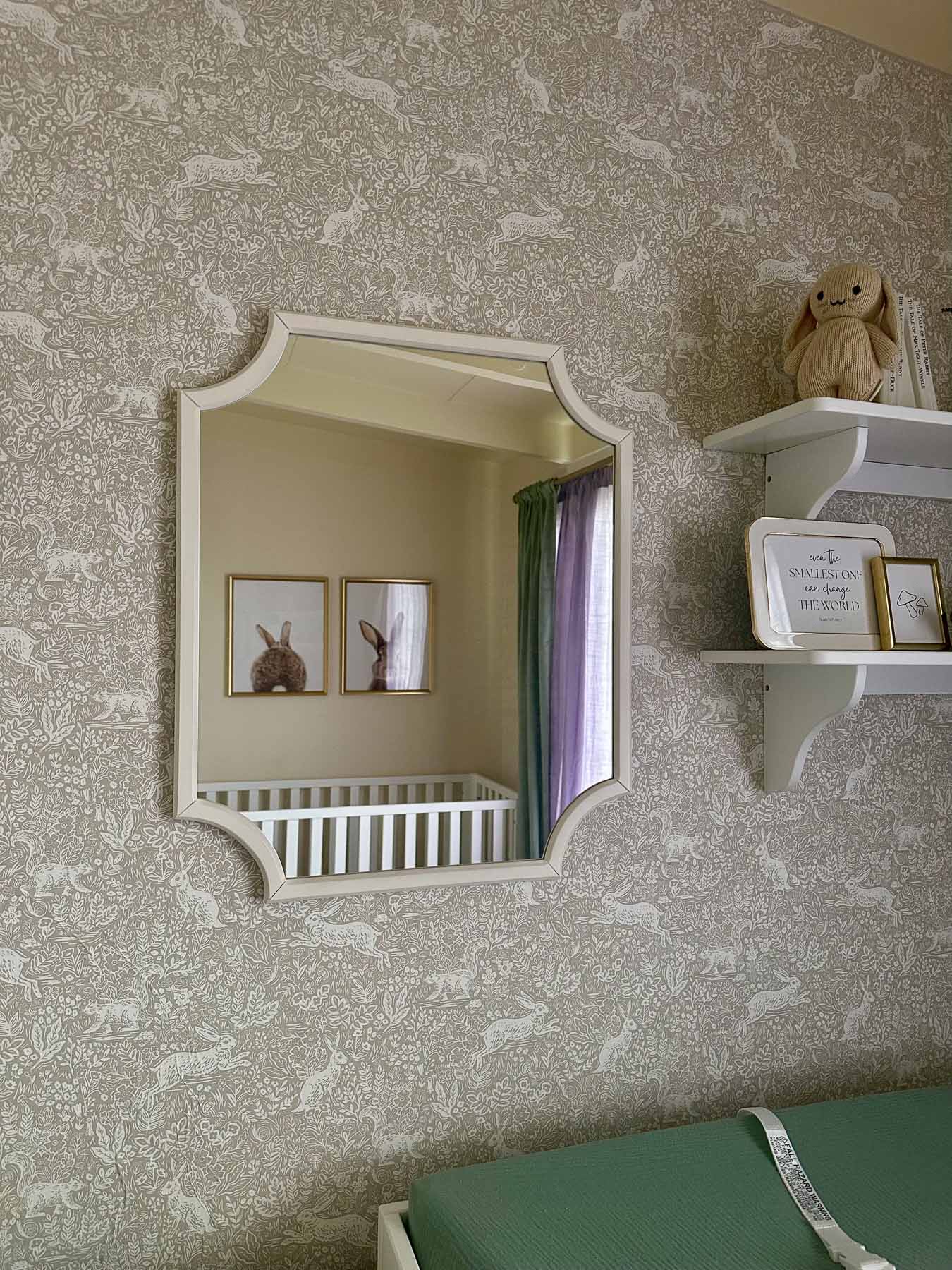
Mirrors can be a bit intimidating to hang in general, but especially in a nursery. But as long as you follow recommended safety instructions and use the appropriate hardware, it’s really quite safe. That said, I personally wouldn’t hang a mirror over a crib, since that just seems like an unnecessary risk.
The wall over a changing table, dresser, or chair is a great place to hang an accent mirror.
Not sure how high to hang your mirror? General interior design guidelines suggest hanging the center of your artwork (or in this case, the mirror) about 57 inches from the floor — in other words, roughly eye level.
However, you may need to adjust for furniture or other constraints. I’ve found that hanging a mirror is almost always a two-person job: one person holds the mirror while the other steps back and assesses the placement.
When hanging your mirror, be sure to follow all safety instructions. Hanging into studs is ideal, but not always possible. In those cases, drywall anchors are your friend. I’ve found that most rentals allow them as long as you spackle and paint when you move out.
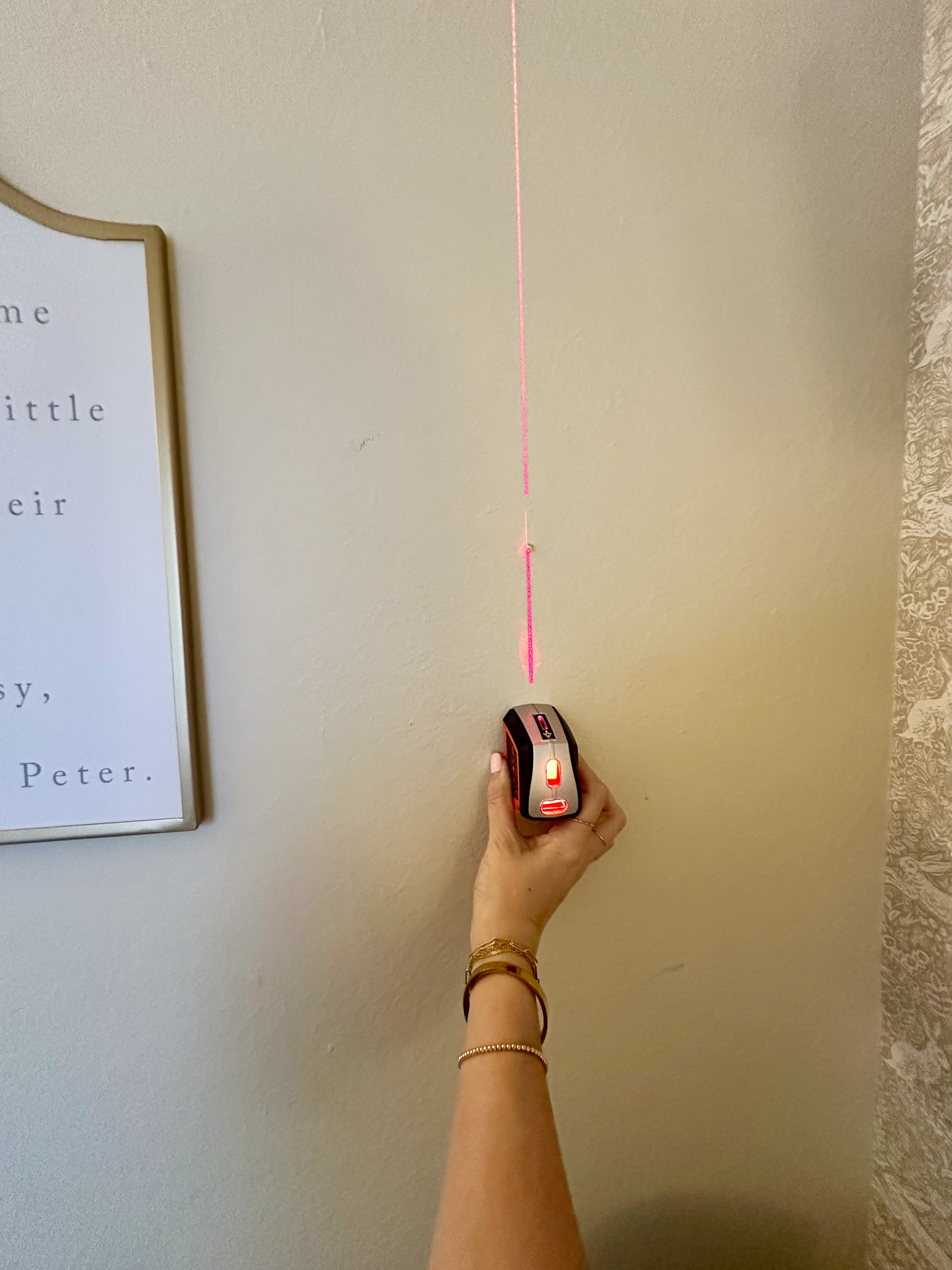
A laser level is also key for keeping your mirror even (I honestly don’t know how we ever hung anything without ours).
If you’re still feeling nervous about hanging one, choose a lighter-weight mirror.
The mirror I chose for our nursery can technically be hung with command strips. I wasn’t comfortable doing that (and on peel-and-stick wallpaper, it would be a disaster waiting to happen), so we still used the included hardware. But it does mean the mirror is lighter-weight, which makes the whole process a lot less stressful than hanging a heavy-duty mirror.
3. Framed Artwork
Framed artwork is a very simple yet effective way to decorate your nursery walls. You can choose pre-made wall art or create your own by selecting specific frames and prints.
If you go the latter route, you have more control over the exact sizes and frames, and it’s usually more budget-friendly. You also get a wider range of customization options for the artwork itself.
The possibilities are endless! You can choose animal illustrations, watercolor paintings, nursery rhymes, meaningful quotes and sayings, affirmations, your baby’s name or initials, alphabet prints, song lyrics, storybook character art, minimalist sketches, and more.
I knew I wanted to hang the classic bunny front and bunny butt prints, so I found some lightweight gold 16×20 frames, bought the artwork as a digital download on Etsy, and printed it at FedEx. (Typically, Etsy sellers offer a wide variety of ratios and sizes that can be adjusted for different frames, but it’s always worth double-checking before purchasing.)
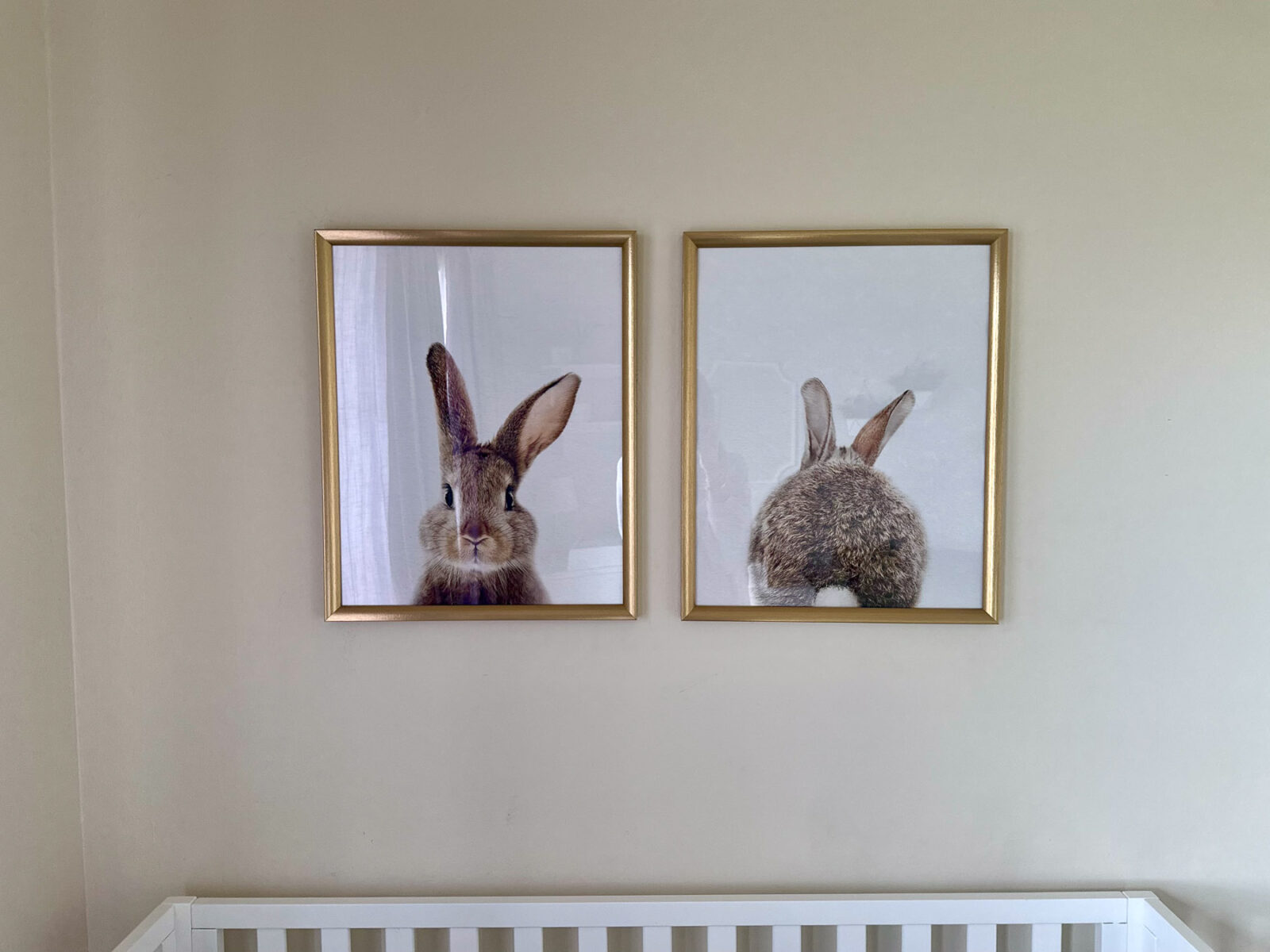
You can also create your own artwork in Canva if you want something more custom.
If printing anything feels like too much work (that’s so real), you can always purchase pre-printed artwork instead. It just tends to be a little more expensive, and it can be harder to find exactly what you’re looking for.
Once your framed artwork is ready, you can hang it as a standalone statement piece or include it in a gallery wall (more on that next). Or both!
I chose to hang my bunny prints over the crib. At first, I was a little hesitant, but the frames are extremely lightweight and use acrylic instead of glass. Since we were able to install them securely, I decided I was comfortable with it. I also added museum putty at the corners for extra stability.
That said, you should always go with your personal comfort level. There are plenty of other great places to hang framed artwork in your nursery if you’d prefer to keep the area above the crib open.
When installing your artwork, a laser level is (again) extremely helpful. And if you’re hanging multiple pieces at the same height, placing a regular level across the tops of both frames is a great way to make sure they’re perfectly even.
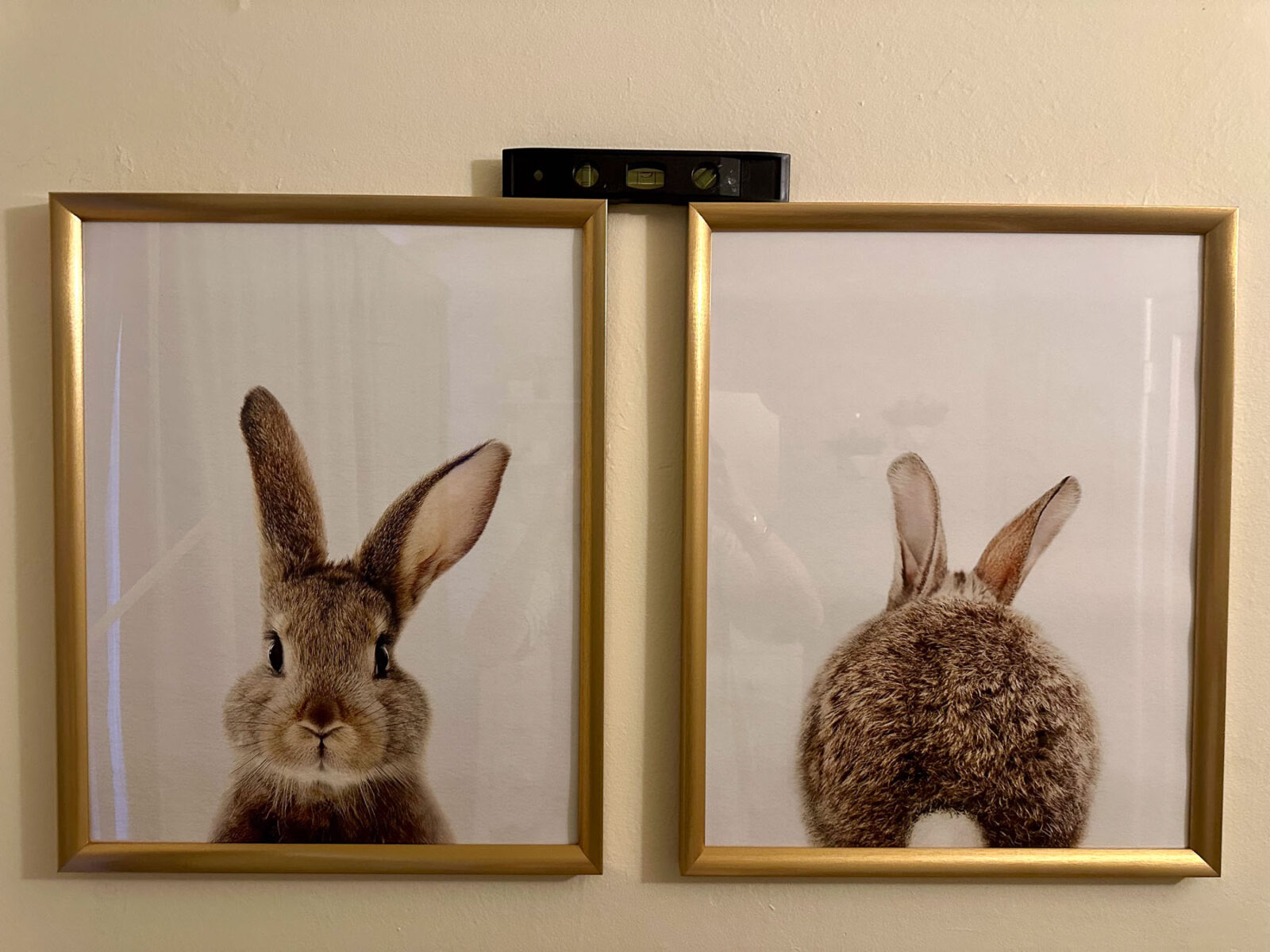
Don’t be surprised if you have to rehang your artwork a couple of times. To minimize that, start by hanging the pieces on small nails just to test the placement. Once you’re confident in the positioning, you can install the proper hardware.
4. Gallery Wall
A fun and creative way to add personality to your nursery is with a gallery wall.
Creating a gallery wall can feel a bit intimidating, but remember that it isn’t supposed to look perfectly symmetrical or even. The eclectic mix of items is part of what makes it charming.
You can include framed artwork, small mirrors, family photos, fabric or textile art, paintings, and more. The key is to have fun with it.

First, measure the wall or portion of the wall you’re planning to use.
As mentioned earlier, the general rule of thumb for hanging height is around 57 inches, although I sometimes go closer to 60 inches. That means the center of your entire gallery wall should fall around that height, though you can adjust as needed for furniture or other constraints.
For width, you can choose to fill an entire wall or concentrate on a narrower area. Just be clear about your goal and make sure you’re targeting a spot the eye will naturally be drawn to.
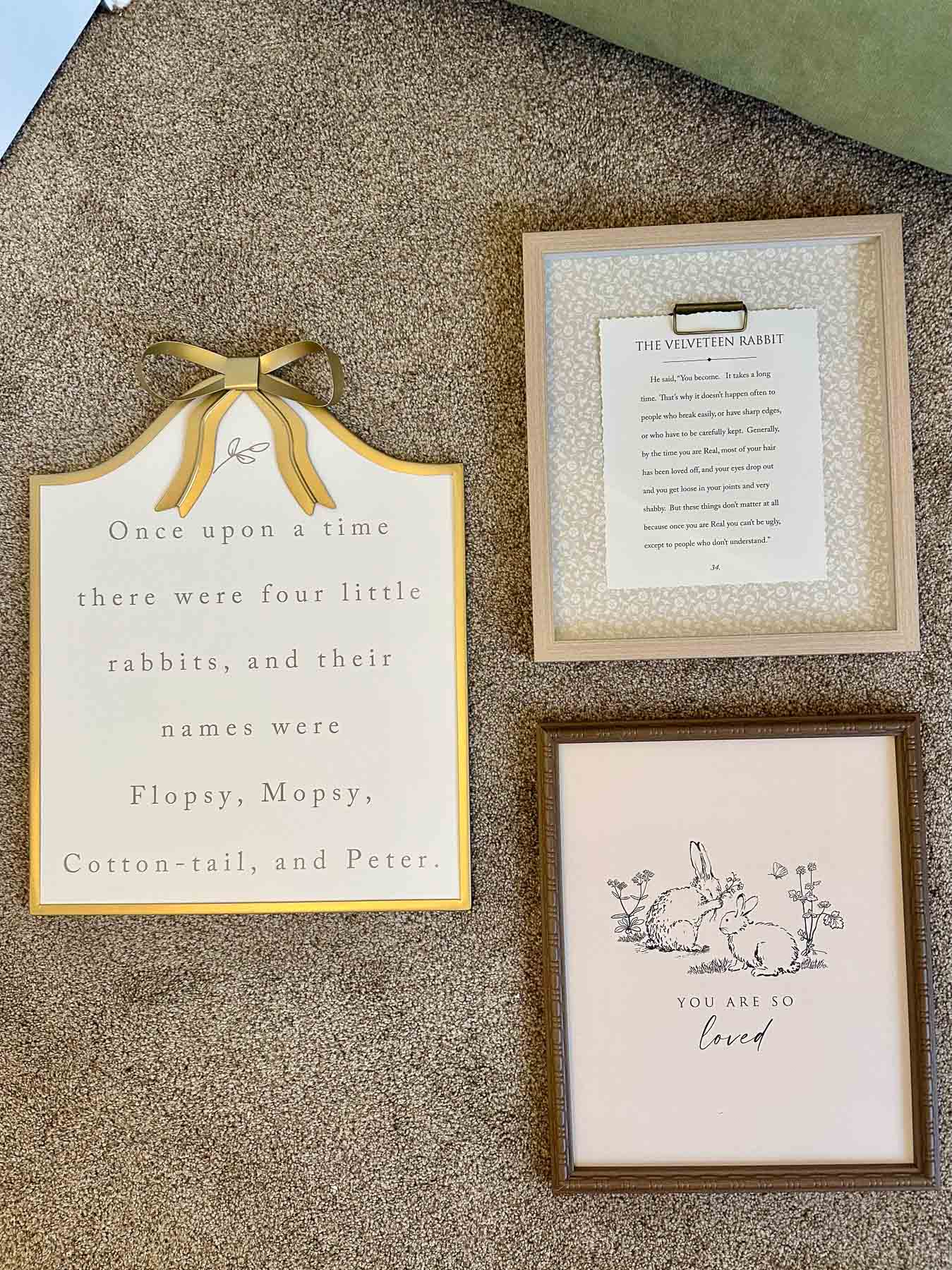
Once you have an idea of the space you’re working with, lay your gallery wall items on the floor to make sure everything fits within your desired dimensions. Aim for about 2-3 inches between pieces, with at least a few inches of breathing room around the edges.
If you don’t have your gallery wall items yet, you can substitute them with books of similar dimensions to test the layout.
Another perk of laying out your decor items on the floor is that you can move them around until you’re happy with the look (not quite as easy when they’re on the wall!). I had originally planned on reversing the order of the two pieces of art on the right, but once I saw it laid out, I realized I preferred them flipped.

Note: ChatGPT is actually surprisingly helpful when making layout decisions. Check out my tutorial on how to use ChatGPT for interior design to learn more!
When it comes to gallery walls, less is more, especially if you’re working with a small space. For my nursery, I chose to use just three pieces of artwork for my gallery wall.


Even though they don’t “belong” together, see how they look cohesive when grouped strategically? While each piece would be cute on its own, they make a stronger statement together.
Once again, when it comes to putting up your gallery wall, do not underestimate the power of a laser level!
5. Floating Shelves
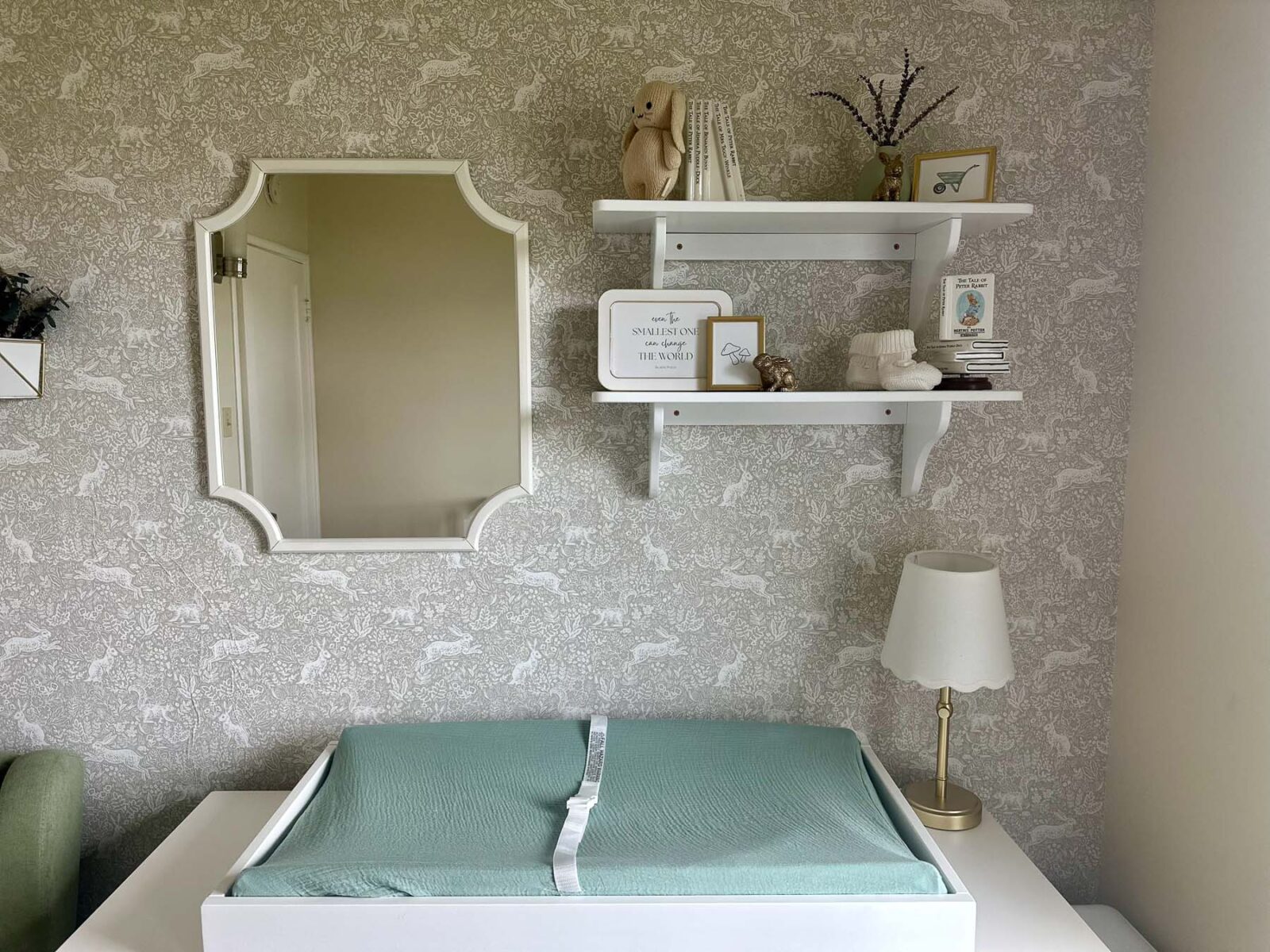
Floating shelves are one of the sweetest decor options for a nursery. They’re beautiful in any room, but in a nursery, you can display the cutest baby-specific items: baby clothes, children’s books, ultrasound or newborn photos, stuffed animals…the list goes on.
These decorative elements help you create little decor vignettes and add so much visual interest and texture to your nursery walls.
First, identify where you want to place your shelves.
I wouldn’t hang floating shelves anywhere within the baby’s reach or over a crib. Even if you install the shelves securely, you can’t fully control the objects placed on them. But aside from that, you can put shelves in lots of other great spots.
We paired ours with our accent mirror over our dresser/changing table.
Our shelves are purely decorative and aren’t designed to hold a lot of weight. But if you choose heavier-duty shelves, you could also include functional items like diaper essentials.
Not all shelves are created equal, and there’s definitely a bit of a learning curve when it comes to installing them (my husband is a hero).
My biggest tip?
Don’t choose shelves that are just flat pieces of wood that screw directly into the wall. They’re extremely unforgiving if they aren’t hung perfectly, and they tend to be less sturdy than shelves with brackets or other elements that brace against the wall.
Our shelves are from Amazon. In addition to blending well with our decor, they were reasonably easy to install.
Once your shelves are up, simply add a few decorative or functional elements, and you’ve got a beautiful design statement.
Looking for tips on how to style your shelves? Check out my tutorial on decorating nursery shelves.

6. Wall Vases
Wall vases are a unique way to add life to the walls of your nursery. The vases themselves can make a statement, especially if you choose ones that match your color scheme or theme.
Then you get to decide how to fill them.
Plants make everything prettier and more vibrant. While I love the idea of using them, I have a (very) brown thumb. But that doesn’t mean you can’t add a little life to your nursery.
Air plants are a great option since they’re pretty hard to kill (although I somehow still manage it after a few months). There’s also no shame in using artificial plants, though I recommend choosing them carefully since quality can vary a lot.
My most recent solution has been using dried greenery and flowers in my wall vases. I used dried eucalyptus and lavender in my bunny-themed nursery for a soft botanical touch.
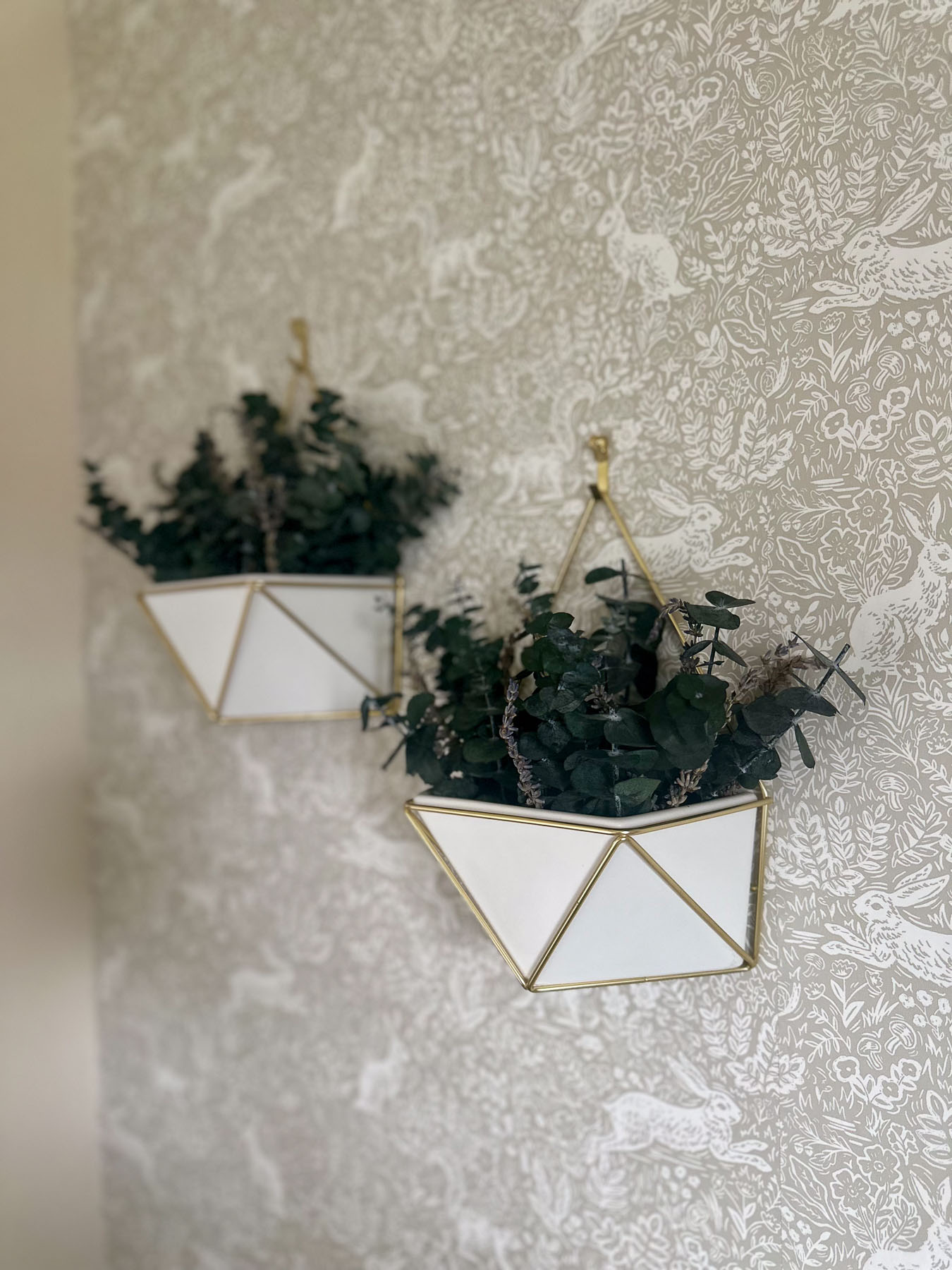
Dried plants last for ages and don’t require watering. Plus, they smell great!
Whatever you decide to put in your wall vases, just make sure they’re hung securely and out of reach. I’d also personally avoid hanging them over a crib, though it ultimately comes down to your comfort level as long as you follow recommended safety guidelines.
Whether you use one or all of these ideas for your nursery walls, the most important thing is to choose decor that brings you joy.
After all, you’re the one who’ll be hanging out in the nursery at 2 a.m., so you might as well spend those sleepless nights in a beautiful space.
Still Designing Your Nursery?
These posts might help.

How to Style Nursery Shelves
Eight practical principles for creating cohesive (and cute!) nursery shelf styling.

