

An Easy Charcuterie Board Template That Wows
I remember the first time I set out to make a charcuterie board. I thought, “This really can’t be that difficult, right?” But as I stared at the empty board, totally lost, I wished I had a charcuterie board template for beginners.
Charcuterie boards are an elegant and practical way to feed a crowd, and they’re so fun for practicing hospitality. But figuring out how to build a charcuterie board that actually looks good can feel overwhelming.
I’m happy to report that after years of practice, research, and training (shout out to my Aunt Candise!), I have come to realize that charcuterie is easier than it looks — but there is a learning curve!
To simplify my life, I created my own charcuterie board template: a visual layout that shows where to place meats, cheeses, and all the extras. You can easily customize it, but it gives you a place to start.
Want a one-page printable version of my go-to layout? Download my template — it’s free when you subscribe to my email list. Or just keep reading — I’ll walk you through exactly how to build your own.
This post contains affiliate links that earn me a commission. For more information, read my disclaimer.
General Tips for a Charcuterie Board Template
Before I dive into the details of how to create a charcuterie board, here are a few general tips to keep in mind.
Be prepared to run out of room.
When you first begin to fill out your charcuterie template, it’s easy to be overly optimistic about how much room you will have for everything. One of the things I love most about charcuterie boards is that they are so celebratory.
The structure of charcuterie boards is intended to give a feeling of brimming over with abundance. So don’t despair when you run out of room in your template!
Remove barriers to eating.
It can be a challenge to get people to eat at social gatherings for a variety of reasons — guests are talking, standing, or worried about spilling on their clothes (or your carpet!).
Charcuterie boards help facilitate eating because they are easy to graze from, but you still want to remove as many barriers to eating as possible. A couple of tips:
- When you can, cut things into small pieces. I typically cut at least one of my hard cheeses into roughly 3/4-inch cubes. In general, the more bite-sized items you have, the more people will eat.
- Remove the rind from soft cheeses like brie. Although some people enjoy the rind (weirdos), it makes it a lot more difficult to slice and eat.
- Provide enough utensils so people don’t have to use their fingers (it’s easier as well as more sanitary).
Think about colors as well as flavors.
Charcuterie is supposed to be beautiful! When you put together a charcuterie board template, consider colors as well as flavors and ensure you have variety and balance.
There’s no exact science here — you can focus on two to three colors or go for a charcuterie rainbow. The key is to ensure the colors are distributed evenly across your board. If it’s visually appetizing, people are more likely to eat it.
Charcuterie Board Template Equipment & Supplies
For a charcuterie board template, you need some basic equipment and supplies.
Equipment for a Charcuterie Board Template
While you can certainly use what you already have in your kitchen, if you invest in some basic equipment for a charcuterie board template, it more than pays off over time.

Charcuterie Board
Any flat board or platter will work. I rotate a few different sizes and materials based on the occasion and number of guests. One of my favorites is from Crate & Barrel.
Utensils
I got a set of cheese knives and some mini spoons and forks from Amazon that I use all the time. They are so versatile!
I recommend cheese knives, but you can also use kitchen knives if they are sharp and small enough. In a pinch, you can also fill a ramekin with toothpicks if you don’t have smaller spoons or forks.
Ramekins
I have a couple of mini ramekins from Sur La Table for dips and jams. Mini things are just so cute and fun, and take up less space on your board.
Ramekins are also great vessels for items like olives or nuts if you want to keep them separate on the board.
Supplies for a Charcuterie Board Template
If you’ve met me, you probably know about my obsession with Trader Joe’s. Their charcuterie supplies are both unique and affordable! Smaller local stores are also excellent places to find special charcuterie elements.
Cheeses
When selecting your cheeses, consider your guests and the size of your board. In general, I recommend at least one hard cheese and one soft cheese. You can add more, but keep the hard-to-soft cheese ratio fairly even.
Hard cheeses such as cheddar, Gouda, and Gruyère are typically crowd-pleasers. Soft cheeses such as brie, burrata, and goat cheese provide textural variety and pair especially well with dips.
You can also add a cheese that’s a little more daring — a blue cheese or something spicy for those with adventurous taste buds.
I firmly believe that every charcuterie board should include Boursin. Does anyone know what kind of cheese it is? Does anyone care? It’s a delicious and flavorful soft cheese, and an essential piece of my charcuterie board template.

Dips
I generally like to use at least two different dips, usually a honey and a jam or spread. There are lots of classic cheese and jam pairings that are tried and true. It’s also fun to lean into seasonal choices:
- Spring: Apricot jam, lavender honey, strawberry balsamic jam.
- Summer: Peach jam, plum jam, raspberry preserves.
- Fall: Fig jam, pepper jelly, pumpkin butter (don’t knock it till you try it!).
- Winter: Apple butter, cranberry relish, orange marmalade.
Charcuterie
You can’t have a charcuterie board without charcuterie!
Try to have at least two different types of meats. I typically use at least salami and prosciutto. Costco has some great variety packs for a bargain if you’re serving a larger crowd!
Crackers
Having a variety of crackers adds visual and flavorful interest to your board. In general, opt for at least one interesting/textured cracker and one more straightforward cracker.
- Trader Joe’s Rosemary Raisin Crisps are my favorite for charcuterie. They’re flavorful and pair well with many different cheeses.
- Buttery crackers like Ritz are always a hit.
- Gluten-free crackers are a good option for guests with allergies.

Fruit/Dried Fruit/Nuts
You can use fresh fruit, dried fruit, or a combination of both. Even adding just one piece of fresh fruit adds a lot of life to your board. This is another great opportunity to embrace seasonal options:
- Spring: Berries, apricots, pineapple.
- Summer: Melons, cherries, peaches.
- Fall: Figs, persimmons, grapes.
- Winter: Pomegranates, pears, oranges.
Dried fruit is also a great addition to your template — apricots or dates are classics. It’s also fun to try to find something unique. Trader Joe’s dried mandarin oranges are my go-to!
Nuts are excellent finger food for people to snack on, and they’re high in protein (yes, of course, charcuterie is healthy!). Adding something special like candied pecans or roasted garlic cashews gives your board a little something extra. I highly recommend Trader Joe’s truffle marcona almonds!

Filling Out the Charcuterie Board Template
Now that you have all your equipment and supplies, it’s time to fill out the charcuterie board template! This is a basic framework that I typically follow and customize as needed.
Want the printable version?
Subscribe to my newsletter below to download them, plus get bonus hosting tips, recipes, and behind-the-scenes updates from Haley’s Comment.

1: Place your cheeses in the template.
Place the cheeses asymmetrically on the board. Put them close enough that they look connected, but far enough apart that there is room for the other elements.
Again, don’t forget to cut at least one of your hard cheeses into smaller pieces for easier access!
I recommend placing the cheeses toward the center of the board, as they are typically the focal point. However, you can place your cubed cheese in a corner of the board, as it’s easier for people to grab it from there.
Do an initial placement of your cheese knives (and forks for cubed cheese), but be prepared to move them later. I recommend placing at least a couple of the knives by doing an initial stab into the cheeses. It helps save room, and no guest feels like they have to make the first slice!

2: Position your dips.
Once you’ve placed your cheeses into the charcuterie template, stage the dips. Like the cheeses, ramekins are more structured than the other elements and need to be evenly distributed across your board.
Don’t forget your small spoons!

3: Add the charcuterie.
It’s always fun to throw in a couple of charcuterie salami roses. They’re so easy to make, and they add an instant wow factor. To make a salami rose, simply layer pieces of salami over the mouth of a champagne flute and then invert the glass.
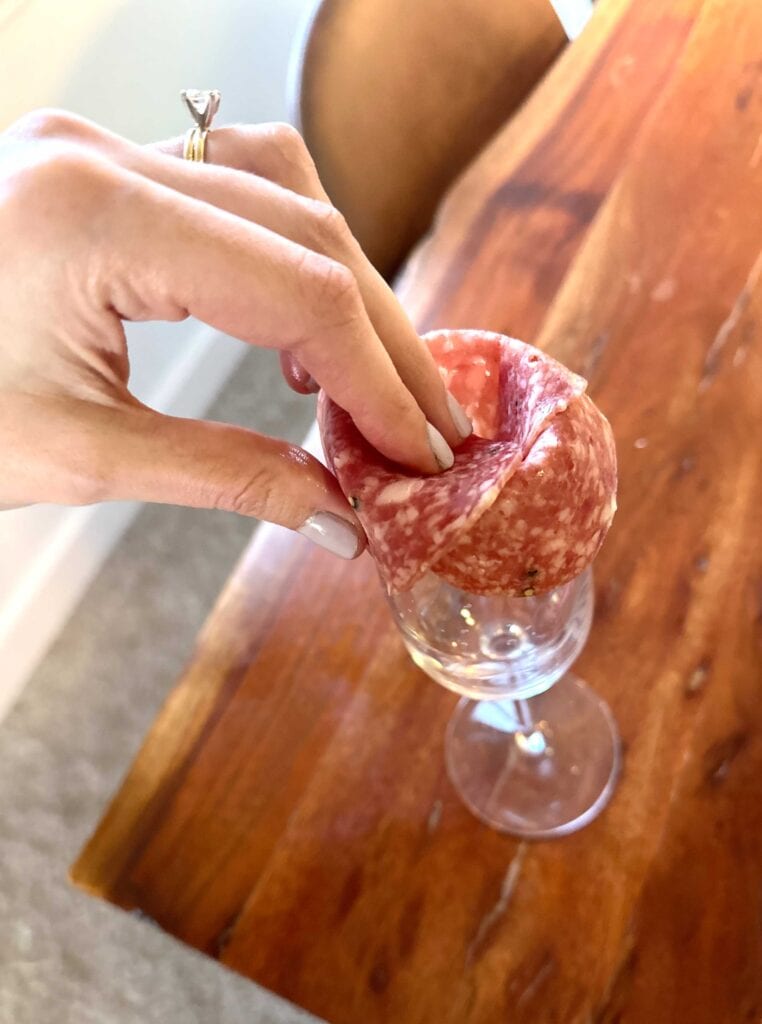
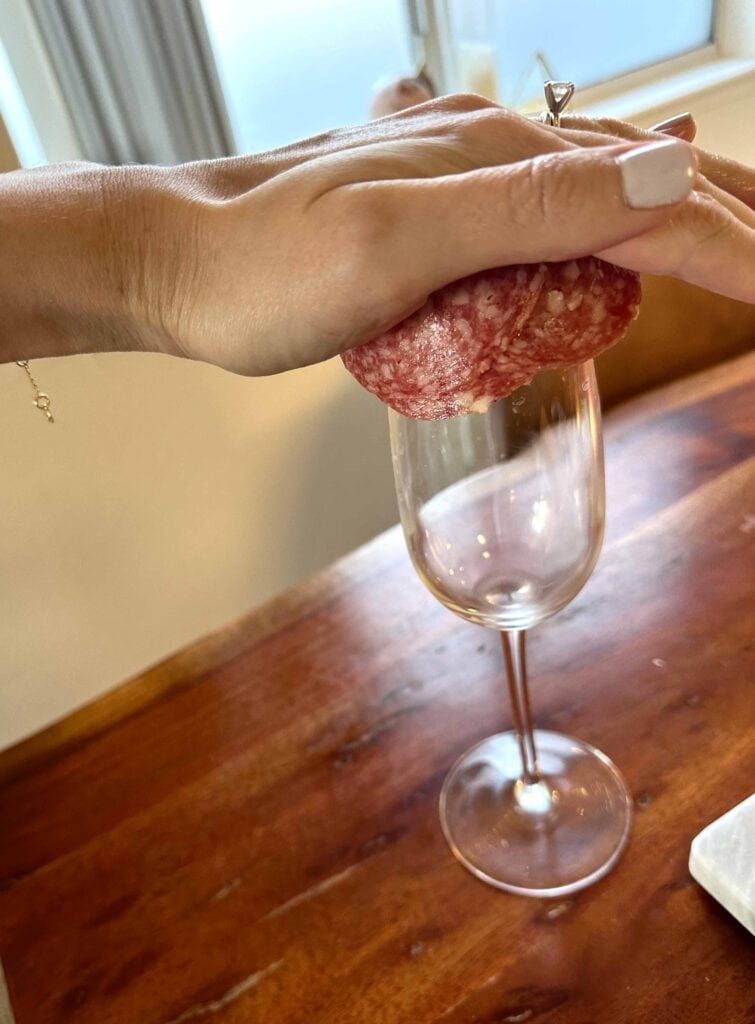

You can also stack pieces of salami on the board — just be sure to pull them apart first, and don’t leave them in the layers that they come in the pack. It looks more natural to layer them yourself.
Prosciutto is great, but it’s a pain to work with (why does it insist on falling apart as soon as you barely touch it?). I recommend rolling it up into little logs because it rarely looks pretty on its own. Add small forks (or provide toothpicks) for people to spear the meats.
Once you’ve decided how to arrange the meats, place them in your charcuterie board template. I usually put them in the corners or toward the edges of the board, as charcuterie also helps provide structure for your board and allows you to fill in the gaps later.

4: Sprinkle in crackers.
You can arrange crackers around the cheeses and the meats however they look best. Again, having multiple types of crackers adds visual interest. Just be sure to leave room for your final touches!

5: Fill in the gaps with fruit, dried fruit, and nuts.
The last piece of the charcuterie board template is to cluster fruit, dried fruit, and nuts. Just try to ensure even color distribution and don’t leave any spaces.
Once all of your items are placed, you may need to rearrange your utensils for ease of access.

6: EAT.
Call me if you need help with this!!
Variations on the Charcuterie Board Template
Voila, you did it! Now that you’ve completed this charcuterie board template, you can customize it and create some variations. A few ways to do this:
- Scale your template up or down by using a smaller board with fewer items or a larger board with more items.
- Pick a cuisine or theme and apply it to your template. For an example of this, read my post on how to create an Asian-inspired charcuterie board.
- Create an allergy-friendly charcuterie board. This can be great to have as an option if you have guests allergic to nuts, gluten, or more. If someone is only mildly allergic, put things in ramekins instead of on the board. If someone is severely allergic, leave those items off the board altogether and substitute.
- Put together a dessert charcuterie board with fruit, cookies, candy, and sweet dips!
Don’t Stop at One Board
Explore more charcuterie ideas perfect for any occasion, from festive holidays to show-stopping spreads that’ll wow your guests.

Impress Your Guests with a Beautiful Asian Charcuterie Board
A colorful, flavor-packed board featuring Asian-inspired ingredients and bold textures your guests won’t forget.

Quick & Cozy Trader Joe’s Fall Charcuterie Board
This fall cheese board is perfectly autumnal and uses all Trader Joe’s items for a warm, festive vibe.

Thanksgiving Charcuterie Board Ideas
Start your holiday gathering off right with this seasonal spread full of cozy flavors and classic touches.
