
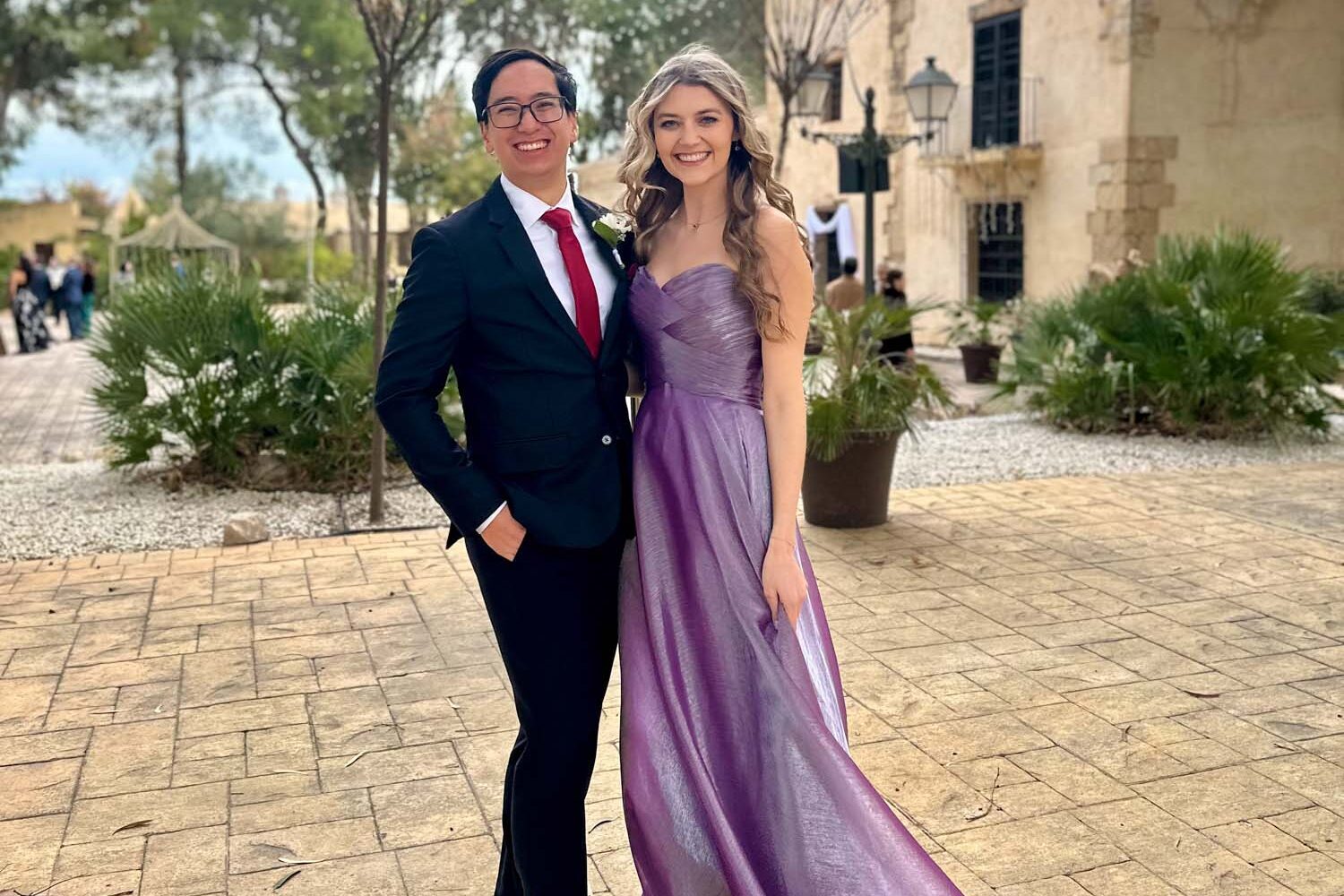
Wedding Guest Attire: What to Wear (and What Not To)
My husband and I love attending weddings. However, as a wedding guest, figuring out what to wear is always a challenge.
Etiquette for wedding guest attire has evolved significantly over the years, and somehow, new names for dress codes (which can be mysterious and undescriptive) are constantly being generated at an alarming rate.
How did we get here? Why is wedding attire so complicated? This guide covers general etiquette for wedding guest attire, how to decode ambiguous dress codes, and tips for figuring out what to wear.
This post contains affiliate links that earn me a commission. For more information, read my disclaimer.

General Etiquette for Wedding Guest Attire
First, let’s talk about some of the general etiquette you should consider when figuring out what to wear as a wedding guest.
Over the past several decades, wedding and fashion etiquette have changed considerably. Some of the “rules” remain in place, while others have changed. There are definitely some dos and don’ts when it comes to wedding guest attire.
Don’t: Wear White
This is the biggest wedding etiquette rule still in existence. Do not wear white to a wedding. Ever.
The only exception is if the bride and groom ask you to wear it. This might seem obvious, but some subtle nuances make this rule more complicated.
All shades of white are included in this: off-white, cream, and ivory. If it has the remotest appearance of white, don’t wear it.
While this rule is more important for women to consider since the bride is typically the only one wearing white, it applies to gentlemen too (sometimes grooms wear white too!). Male guests can (and should) wear white shirts, but should avoid white suits, ties, or tuxedos.
For women, a valid question that often arises is what if you have a dress that has both color and white? A good practice is to show a friend what you’re planning to wear and ask them to tell you what color it is.
For example, if you show them a blue dress with white flowers, do they say it’s a blue dress? If they say it’s a white dress or even a blue-and-white dress, skip wearing it.

Bridal stylist Katie Hubbard offers some helpful advice here: “I always say if you are questioning whether it is too much white, it probably is.”
Don’t: Wear Anything Too Bright or Distracting
In general, most colors other than white are allowable. However, extremely bright colors, loud prints, or extravagant styles may not be the best choice. As a wedding guest, your goal should be to look nice while standing out as little as possible to allow the bride, groom, and wedding party to shine.
Obviously, you should wear something fun that makes you feel good! But if you’re considering wearing something that could potentially derail a wedding photo, maybe consider another option.
Don’t: Wear Anything Scandalous
A wedding is not the time to wear your most revealing outfit, and it’s important to steer clear of anything scandalous or provocative. Weddings are diverse gatherings with a variety of ages and cultures.
Also, scandalous clothing can be distracting, which we just established is a big wedding guest attire no-no.
Be considerate of cut, fit, and length when selecting your outfit. Ask yourself two questions: 1) Could this offend someone’s grandma? 2) Could this cause someone to look at me instead of the bride?
If the answer to either of those questions is yes, you need to find another outfit.
Don’t: Wear Anything Too Casual
We’ll get into decoding confusing wedding guest dress codes later in this post, but it’s important to stay away from anything too casual, even if the word “casual” is in the dress code.
As a general rule, unless the bride and groom specifically ask you to wear it, you should never wear denim, athleisure, a t-shirt, a Hawaiian shirt, casual sneakers, or flip-flops.
Do: Wear Something Celebratory & Fun
A wedding is a special occasion. The bride and groom have invited you to celebrate with them, and wearing something nice makes them feel appreciated.
Also, getting dressed up is a treat, and you should wear something that makes you feel great.
Although you don’t want to upstage the happy couple or wedding party, that doesn’t mean you shouldn’t look fabulous. As long as you keep general etiquette in mind, you can absolutely dress to look your best. That’s part of the fun of weddings!

Do: Wear Black (If You Want To!)
Wearing black to a wedding used to be a big fashion faux pas, as this color was typically associated with mourning. However, as etiquette has evolved, so has this rule.
Black is a very practical color for a wedding guest, as it is classic, flattering, and can be dressed up or down. Especially for evening weddings or black-tie/black-tie optional weddings, black can be a great choice for wedding guest attire.
While wearing black has become generally accepted, for certain cultures, it can still be a no-no, which brings me to my next point.
Do: Consider Cultures, Weather, & Time of Day
It’s important to consider all the variables involved when you’re deciding what to wear to a wedding, including culture, weather, and time of day.
Certain cultures have different fashion rules for wedding guests.
For example, you shouldn’t wear red, black, or white to a traditional Chinese wedding, according to The Knot. That’s because in Chinese culture, red is traditionally worn by the bride, and both black and white are associated with mourning.
When planning your outfit, think about the cultures of the bride, groom, and their families, and do your research accordingly to understand any cultural expectations you might be unaware of.
It’s also important to consider the weather and time of day.
For example, a daytime, outdoor wedding generally has a much more casual feel than an evening, indoor wedding. If it’s an outdoor wedding, ensure you wear proper footwear — stiletto heels and grass are not a good combination.

Additionally, you may need sun protection and appropriate outerwear such as a jacket or coat.
Pro tip: Be sure that any outerwear goes well with your outfit by trying it on together beforehand. And don’t forget, not wearing white applies to coats and jackets as well!
Do: Follow the Dress Code
We’ll talk more about confusing dress codes later, but it is very important to comply with the expressed wishes of the bride and groom.
Obviously, this means you should do your best to follow whatever general dress code they have specified. However, it’s also become increasingly common for couples to have very specific requests for wedding guests, such as wearing a particular color or style.
Personally, I think that requiring a specific outfit for wedding guests is asking a lot. However, even if you do not agree with the couple’s wishes, since it is their special day, it is important to adhere to them.
Decoding Ambiguous Wedding Dress Codes
Now that we’ve gone over general etiquette, let’s talk about navigating confusing dress codes!
Dress codes can be ambiguous, and people define them differently, which makes it hard to know what is intended. Often, people create new dress codes that are even harder to understand.
What exactly is barnyard chic? Country club casual? Brooklyn formal?
How are you supposed to know? How can you avoid offending? No one wants to be over (or under) dressed for a wedding.
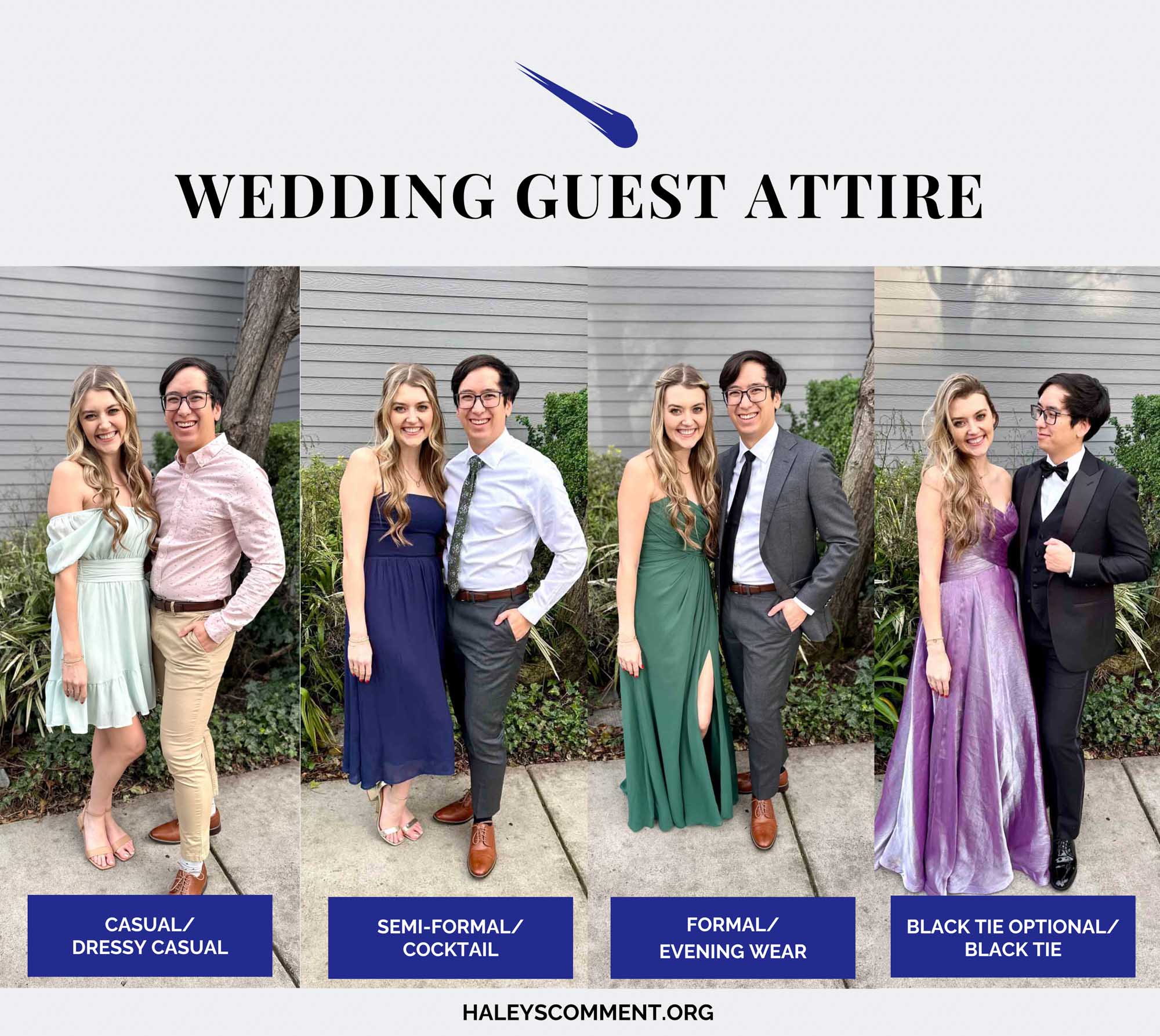
I’ve broken down wedding guest attire into the following categories:
- Casual/Dressy Casual
- Semi-Formal/Cocktail
- Formal/Evening Wear
- Black Tie Optional/Black Tie
- White Tie
In general, all wedding dress codes typically fall into one of these categories. If your dress code has a unique name, you just need to figure out which one it aligns most closely with.
I’ll go into more detail about each of these dress codes and provide examples for most of them.
Casual/Dressy Casual
The first dress code is casual or dressy casual. Other names for this dress code are smart casual, business casual, beach casual, or country club casual.
Essentially, if the word “casual” is in the dress code, you’re probably safe in this category, although you still need to factor in the setting, weather, etc., as mentioned earlier.
To clarify, casual attire for a wedding does not mean the same casual clothing you’d wear to run errands. (Again, denim and athleisure are always off-limits unless otherwise specified by the bride and groom.)
Casual means that the bride and groom are going for a more laid-back vibe and want their guests to be comfortable. When you consider your outfit, plan something that looks nice without being too fancy.
You have a lot of creative liberty with this dress code, so have fun with it!
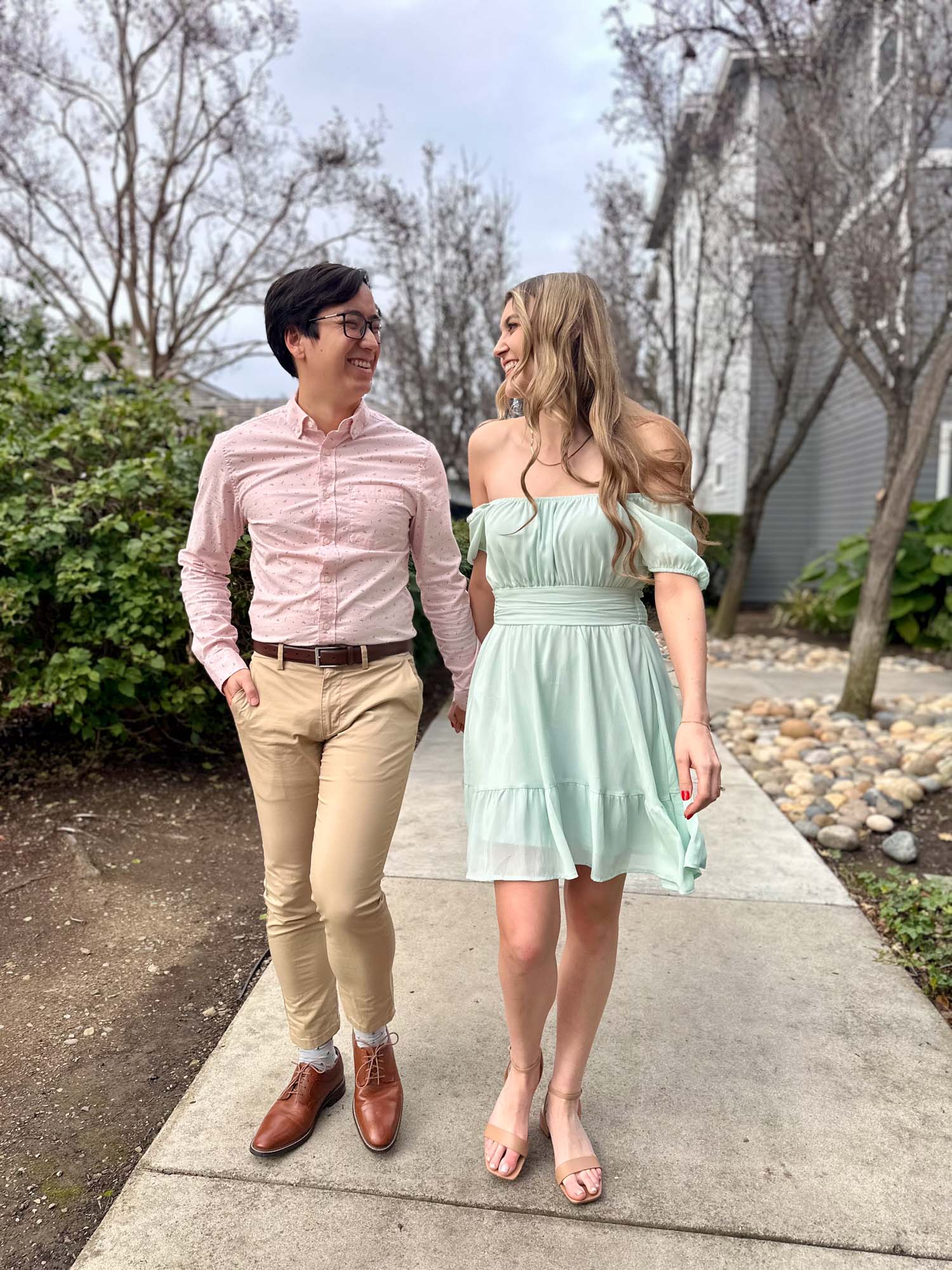
Ladies: Casual/Dressy Casual
Ladies can wear sundresses, nice tops with skirts or slacks, or casual jumpsuits. You can choose more informal footwear, such as sandals, wedges, or flats.
Let your style shine with accessories, but avoid jewelry or hairstyles that are overly formal.
Gentlemen: Casual/Dressy Casual
Gentlemen can wear khakis or chinos and a nice button-down. You can choose from a range of footwear, such as Oxfords, loafers, or dress boots.
Pro tip: Regardless of the level of formality, don’t forget that your belt and shoes should always be in the same color family!
Semi-Formal/Cocktail
The majority of weddings I have attended are either semi-formal or cocktail. Unless the dress code specifies a higher level of formality or some unusual/specific dress code, you are generally well off picking something in this category.
Supposedly, there is a difference between semi-formal and cocktail. However, in my research, I found different sources with conflicting information on which is more formal, which indicates to me that there isn’t much difference between the two.
Generally speaking, cocktail attire is associated with being slightly more formal.
Regardless of which is technically dressier, I’ve found that they are in practice pretty similar. Semi-formal/cocktail has become a sort of catch-all dress code that indicates guests should dress up a bit without requiring anything specific or overly fancy.

Ladies: Semi-Formal/Cocktail
For semi-formal and cocktail weddings, ladies can wear a cocktail dress, midi-length dress, or dressy jumpsuit. You can choose a fun color or pattern, provided the style and fabric of your outfit are dressy enough.
Steer clear of formal, full-length dresses, as you will stand out.
For footwear, consider dressy flats, strappy-heeled sandals, or pumps. Choose fun, elegant accessories that complement your outfit.
Gentlemen: Semi-Formal/Cocktail
For semi-formal weddings, gentlemen can choose to wear a full suit or pair slacks with a button-down and blazer, if you prefer. Less formal, lighter suit colors, such as gray or blue, are permissible.
As always, consider the time of day — a daytime wedding dictates a lighter suit color than an evening wedding.
Having attended quite a few semi-formal weddings, I would say that you can probably safely forego either a jacket or a tie — I recommend keeping at least one of the two (Disclaimer: I do live in California, which tends to be more casual).
Feel free to choose fun patterns and colors for ties and socks!
According to Brides, if cocktail attire is specified, then gentlemen are expected to wear a full suit. I would not necessarily agree with that, given my experience as a wedding guest, but when in doubt, bring a suit jacket. If no one else is wearing theirs, you can easily remove it.
For semi-formal/cocktail attire footwear, select dress shoes that complement your outfit.
Formal/Evening Wear
Formal attire or evening wear is probably the second most common wedding dress code I have encountered. If the bride and groom specify formal or evening attire, it means they are looking to create a more upscale atmosphere.
There are more expectations and less flexibility here than with the previous dress codes — you need to follow certain guidelines or risk being underdressed!

Ladies: Formal/Evening Wear
For formal attire, ladies should wear a formal dress or gown.
Generally, it’s easiest to pull off formal wear with a full-length dress, but it can be knee- or midi-length if the fabric and style are dressy enough. To be on the safe side, I usually err on the side of formality and choose something floor-length.
Although many jumpsuits or matching sets are not formal enough for this dress code, if you find one that is appropriately dressy, that can also work well.
When selecting formal wear, it’s generally best to choose darker colors as opposed to brighter or lighter shades. Additionally, be sure to avoid casual fabrics such as cotton or linen and select more formal ones such as satin, silk, or chiffon.
For formal attire, you can opt for a more formal hairstyle and accessories. Often, this look involves timeless, understated jewelry, but you have creative liberty as long as it complements your outfit well.
When considering footwear, you have a range of choices. In the past, heels have typically been expected with formal attire. However, this rule has changed in recent years, and there are many options for formal footwear.
Just ensure that your shoes match the level of formality of your dress (although with a floor-length dress, they won’t show much anyway).
Also, if you choose a floor-length dress, be sure to get it tailored correctly — approximately one inch off the floor, just skimming the tops of your shoes.
Gentlemen: Formal/Evening Wear
For formal attire, gentlemen should wear a dark-colored full suit (such as dark navy, charcoal, or black) and a tie. Avoid excessive patterns or adventurous socks and ties, and select formal footwear that complements your suit.
Black Tie Optional/Black Tie
For most weddings, black tie optional/black tie is usually about as formal as it gets! This dress code is similar to formal wear but takes it up a notch. Although it can be intimidating, view it as a fun opportunity to get dressed up!

Ladies: Black Tie Optional/Black Tie
For black tie optional or black tie, ladies should wear a formal dress or evening gown. According to Harper’s Bazaar, this should preferably be floor-length but can also be mid-length.
Again, to err on the safe side, I would opt for floor-length. Choose darker colors and formal fabrics such as tulle, crepe, or organza.
The line between formal and black-tie dresses is a little blurry, as many dresses work for both dress codes. However, a dress for a black-tie/black-tie optional wedding can be a bit more “extra” than one for a formal wedding, with features such as beading, sequins, or appliqué.
Similar to formal attire, choose footwear and accessories that are the appropriate level of formality and complement your outfit well without overwhelming it.
To Train or Not to Train?
When it comes to more formal dresses and evening gowns, an important question arises: Is it appropriate for a wedding guest to wear a dress with a train?
My research on this was inconclusive, although much of what I found online pertained to actual wedding dress trains. To me, this indicates that a train is perhaps something that should be reserved for the bride.
Since wedding dress fashion has evolved so much, you never know exactly what the bride is going to wear. She might have a train that is shorter than yours, or not have one at all, and you don’t want to appear as if you’re trying to upstage her. My advice would be to skip the train just to be safe!
Gentlemen: Black Tie Optional/Black Tie
Gentlemen don’t have as many choices for this level of dress code as ladies do, as the dress code for black tie/black tie optional is very specific.
For black-tie attire, a full tuxedo is expected: shirt, waistcoat or cumberbund, jacket, trousers, and bow tie. Don’t forget cuff links (and studs, if applicable)! Tuxedo shoes are traditionally formal and made of patent leather.
For black tie optional, men can choose between a tuxedo and a dark-colored, formal suit and tie.
White Tie
White-tie attire reaches the absolute upper limit of wedding formality. I have never been to a white-tie wedding or even heard of anyone I know having one, so I have no pictures to show as attire examples.
Although white-tie weddings are rare today, should you ever have the occasion, you need to be prepared. This dress code is as formal as it can get, so you’ll need to go all out!
Ladies: White Tie
For white-tie attire, ladies should wear a very formal ball gown, as if attending a gala or opening night at the opera. As long as you remember the wedding guest attire etiquette mentioned previously, it will be hard to find a dress that is too formal for this dress code. Think full skirts, elaborate fabrics, and dramatic styles: the sky is the limit!
You can accessorize your gown with decorated footwear, statement jewelry, and a headpiece. I would just be wary of anything resembling a tiara — if the bride isn’t wearing a dramatic headpiece, you don’t want to wear one.
While I stand by my previous recommendation to generally not wear a dress with a train, white-tie attire may be the exception.
For a white-tie wedding, it’s likely the bride’s dress is more elaborate and has a longer train than anything you would possibly wear. You can check with a member of the wedding party to determine whether a train would be appropriate.
Gentlemen: White Tie
For white-tie attire, gentlemen should wear a full tuxedo, complete with coattails. According to Fine Tuxedos, white-tie attire also includes accessories of a white pique tuxedo shirt, white pique tuxedo vest, and a matching white bow tie.
The expected footwear for this dress code is opera pump shoes.
How to Decide What to Wear to a Wedding
Now that we’ve gone over the different wedding dress codes, let’s talk about how to decide what to wear. Even when you know what the dress code is and what it means, it can still be challenging to pick your outfit.
After all, you don’t know how other people will interpret the dress code, and you don’t want to stand out (in a bad way).

Here are the steps I follow when deciding what to wear to a wedding.
1. Read the Dress Code
The first step in deciding what to wear to a wedding is to read the dress code. This may seem obvious, but if you’re not careful, you can miss some important information.
Generally, the dress code should be communicated in your invitation. However, many couples include additional helpful details in emails or on their wedding website.
Speaking as a former (and very frazzled) bride, be sure to read all printed and email communications from the couple. Also, check the entire website (including the FAQs) for information about what to wear.
It’s becoming increasingly common for the bride and groom to give further details or examples of what to wear, which will be very helpful when making your decision.
2. Research the Venue
When deciding what to wear to a wedding, a good next step is to research the venue, as this has a huge impact on the dress code. Although the dress code might be the same (for example, dressy casual or semi-formal) for a wedding at a barn, beach, or winery, you would likely wear three very different outfits to these weddings.
To elaborate on this example further, the dress code for my wedding was semi-formal. However, since it was at a golf course, the venue suggests a higher level of formality than a beach or garden, but a lower level than a fancy hotel or ballroom.

Pro tip: Look up the venue on Google Maps (you can find the location on your wedding invitation or the wedding website) and take a look at some of the photos.
You will probably find pictures of other weddings at the venue and can get inspiration from what previous guests have worn. At the very least, you will find photos of the venue itself and can get a feel for what the surroundings and terrain will be like.
3. Figure Out What the Wedding Party Is Wearing
If you’re still not sure what to wear, try to figure out what the wedding party is wearing.

Gentlemen, trying to decide if you should wear a suit jacket? If the groomsmen aren’t wearing them, then you should probably skip it.
Ladies, it’s not the end of the world if you accidentally match the bridesmaids, but I think most of us would prefer to avoid that.
Identifying the wedding colors is usually not too difficult, as they are often represented in the invitations or website. If you’re unsure, try asking another wedding guest, a member of the wedding party, or the bride/groom — assuming they’re far enough along in their planning and aren’t too stressed out.
If possible, getting more information about the bridesmaid dresses’ color and style will help ladies determine the color, length, and formality of their outfits. Similarly, understanding what the groomsmen are wearing will help gentlemen know how formal to be.
Figuring this out in advance is a good way to ensure you don’t look like you’re trying to upstage anyone and will help you blend in on the wedding day.
4. Figure Out What Other Guests Are Wearing
If you can, find out what at least one other guest (whose fashion opinion you trust) is wearing. This is one of the most important steps in deciding what to wear!
Understanding what other people are wearing will help you get a feel for whether you’re interpreting the dress code correctly. Also, if you’re unsure of your choice, you at least know that you won’t be totally alone and that there will be someone else attending who is in a similar boat.
5. When In Doubt, Wear Something Safe
If you’ve followed all the above steps and are still unsure of what to wear, when in doubt, wear something safe.
A few ideas for safe options:
- Ladies
- If you’re unsure of how long/formal your dress should be, choose a midi-length dress as a compromise.
- Consider wearing a little black dress (LBD) as this is a classic and versatile choice.
- Don’t wear a formal, floor-length dress unless you know other ladies are wearing them.

- Gentlemen
- Steer clear of adventurous patterns and stick to classic styles.
- Select a navy or dark gray suit, both flexible choices that can be appropriate for both more formal and casual settings.
- If you are unsure whether or not you should wear a suit jacket or blazer, wear one and take it off if other guests aren’t wearing them.
Figuring out what to wear as a wedding guest can be challenging. However, getting dressed up to celebrate your loved ones is also a lot of fun!
By considering general etiquette, understanding confusing dress codes, and walking through a few practical steps to determine what to wear, you can find a great outfit appropriate for any wedding celebration.
Planning a Wedding?
Check out these guides to make your special day unforgettable.

How to Plan a Big Wedding on a Budget
Tips and tricks to pull off a stunning celebration without breaking the bank (yes, it is possible!).

I Tested an AI Wedding Planner: What the Prompts Got Right & Wrong
Can AI plan your wedding? I put it to the test. Here’s what actually helped (and what didn’t).

